Cancellations
Orders that don’t turn into revenue, with costs you may still have to cover.
 Calculate my disruption cost →
Free calculator for Indian ecommerce sellers
Lost margins, return shipping and extra fulfilment work can add up. Use your own order numbers to estimate the cost—and see what fewer disrupted orders could mean for your business.
Free · Personalised estimate · Around 2–3 minutes

The problem
A delayed dispatch. A cancelled order. A parcel returned to your warehouse. Each creates costs that your sales figures alone won’t show.
Orders that don’t turn into revenue, with costs you may still have to cover.
Reverse shipping and handling that add to your expenses.
Overtime, extra staff and urgent shipping that put pressure on margins.
Applicable charges that add to the cost of affected orders.
What it calculates
Estimate charges associated with cancelled orders.
Estimate the contribution you miss out on when orders are cancelled.
Include reverse-shipping and handling costs using the values you provide.
Factor in overtime, temporary staff, premium shipping and additional warehouse or 3PL costs.
Add applicable charges based on your own seller terms.
Improvement scenarios
Compare your current estimate with scenarios where affected orders fall by 25% or 50%. See how the estimated exposure changes and where improvements could make a difference.
Estimated exposure change
Calculated from your own inputs
Estimated exposure change
Calculated from your own inputs
Start with your order numbers. Get a clearer view of the costs that deserve your attention.
Free · Around 2–3 minutes · No credit card required
A clearer planning view
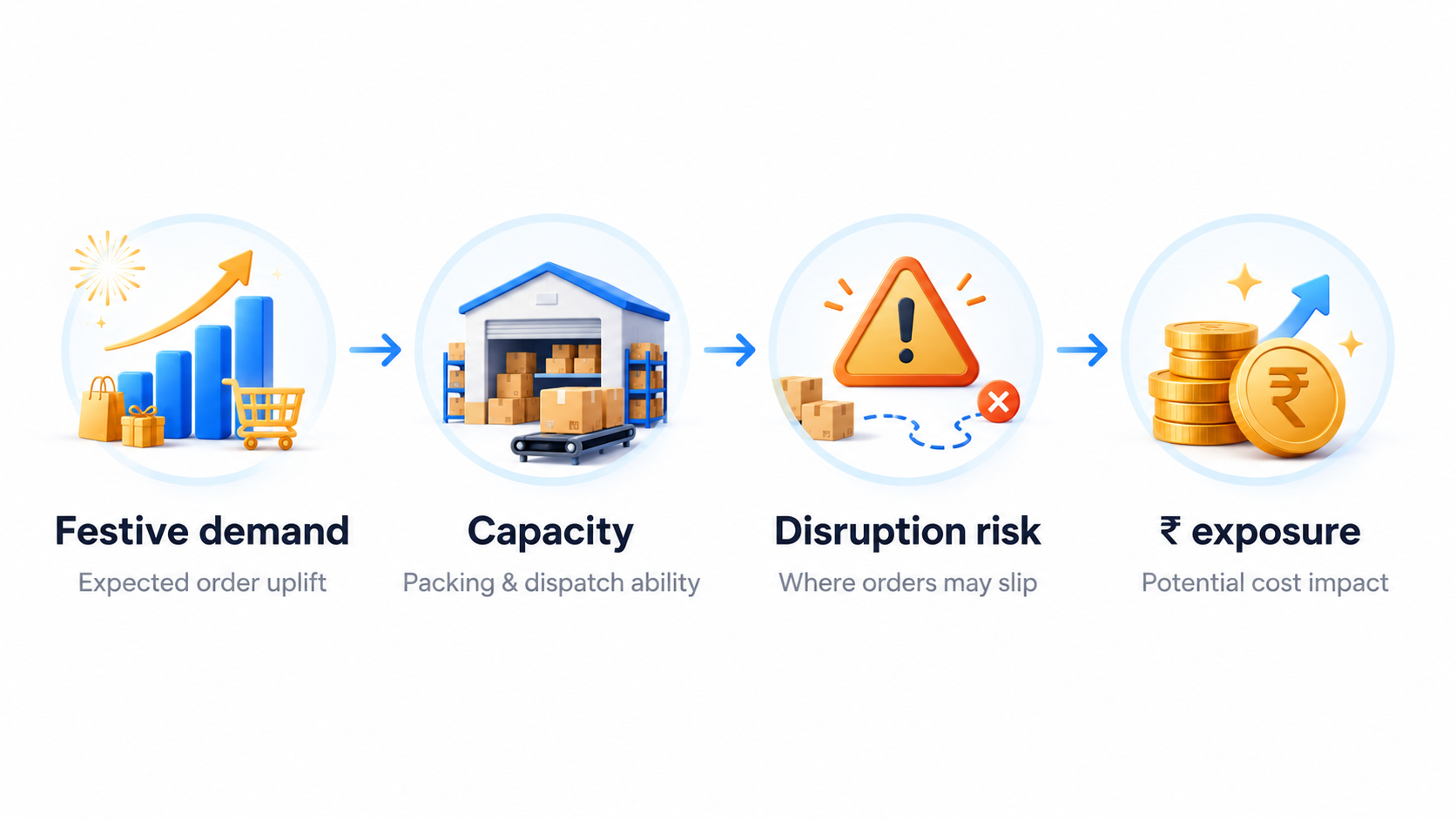
Add your order volume, average order value, dispatch risk and missed pickups.
Include your margin, return handling, additional fulfilment costs and applicable marketplace charges.
See your cost breakdown, biggest area of exposure and potential impact of fewer affected orders.
Questions, answered
The calculator is designed to help you examine inputs, not make assumptions for you.
Depending on your inputs, it can include cancellation-related charges, lost contribution, return and RTO handling, additional fulfilment costs and marketplace charges you enter.
Yes. Use a typical week’s numbers to understand everyday operational costs, or a busier week’s figures to explore higher-volume scenarios. Keep all inputs consistent with the period requested in the calculator.
The estimate depends on the numbers and assumptions you provide. Use it to support operational planning; it is not an accounting forecast.
It does not automatically determine every applicable marketplace charge. Enter seller-specific charges where requested, based on your own terms.
No. They illustrate how estimated exposure changes when affected orders decrease. Actual outcomes depend on which issues you resolve and the cost of making those improvements.